Tuesday, February 17, 2015

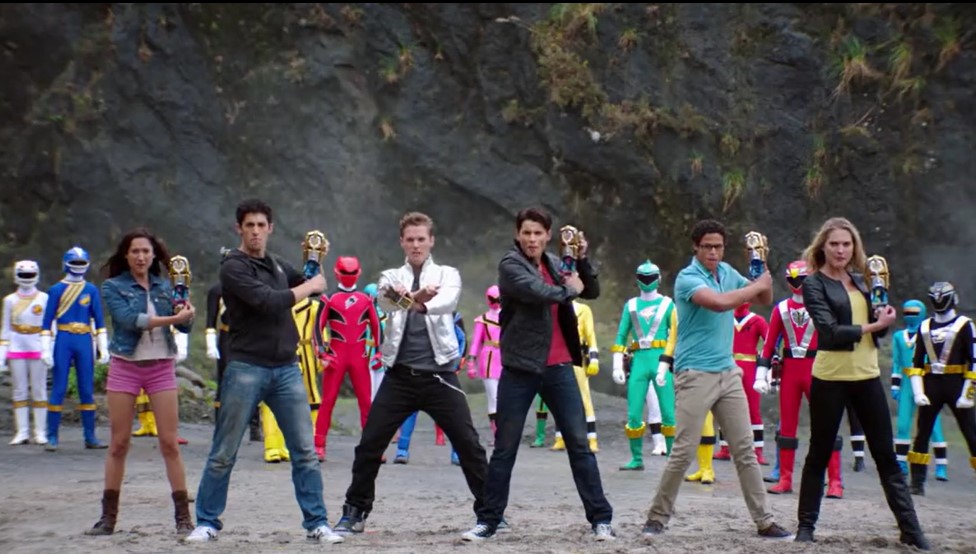
Power Rangers Dino Charge First Impressions

After watching the first two episodes of Dino Charge, I have to say that I am pleasantly surprised. I wasn't really expecting that much from the show after last 4 years. Anyway, lets get down to business. Note: this will include both episodes since it was technically a two part premier.
I actually enjoy the theme song this time around despite it using some lines of the remixes from the last few years. It has this slightly ancient vibe to it in the beginning of the song. The song actually synched up rather well with the opening, especially that clip of Koda punching Fury.

First Episode: 
The first episode opens up with a space battle between Keeper's and Sledge's ships. The CGI used for the battle and the inside of Sledge's ship could have been used better. I was waiting for him to walk right through the green screen when they showed the command deck. Sledge's design leaves a lot to be desired since it is essentially just a green body suit with foam armor on it. Despite his design, the show does a relatively decent job of show how strong Sledge is. You don't actually see him fight in the episode but there is a scene of him just cataloging prisoners in his ships prison block and carrying wanted posters.
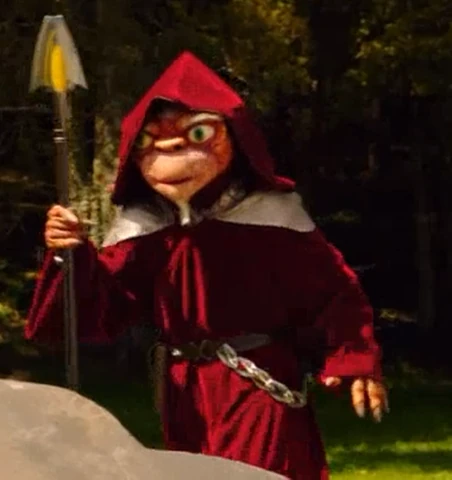
Keeper is the mentor of the season and well, his design is alright. He looks like an older, wiser ET that turned orange. However, with only 3-5 minutes of screen time in this episode, I can honestly say that he has already done more than the last two mentors. He seems to have some degree of fighting skills given that he fought Fury for a brief bit after sending out the energems.
One of the surprising things is that the monster of the week actually went right for the kill the moment he knocked the energems away from Shelby and Tyler. He only failed because he was about a second too late. In an interesting choice, only Tyler and Shelby actually morph and fight during this episode. The fight scene that followed could've used some work. It feels out of synch due to all the wireworks and it didn't feel like it flowed naturally. The CGI for the T-Rex zord...yeah there was no way I could take that seriously when it attacked the monster of the week.

Second Episode: 
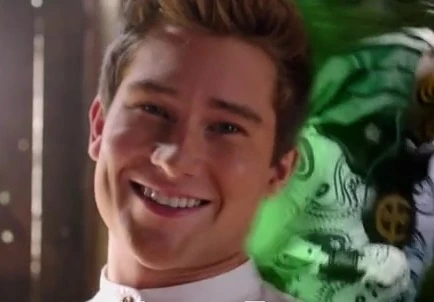
Riley's introduction is a rather odd choice in terms of skill set. He is a rancher but also a fencer which doesn't really mesh convincingly with KyoryuGreen's reverse grip sword-style in the footage used later in the episode. In an unmorphed fight scene, Riley manages to beat out Fury in a sword fight to protect the green energem. Chase and Koda are revealed to already have their powers. I'm actually a bit surprised about Koda's lines. I half-expected him to speak fluently despite being a caveman. Sort of glad they went with the fractured dialogue. Though the caveman thing wasn't actually mentioned in the show but I think they'll probably give his backstory soon. The morphed fight is sadly Kyoryuger stock footage from their premier.

Final Thoughts: I definitely needed this. I went into this expecting Megaforce levels of cash-in and honestly, I'm pleasantly surprised. While not a perfect start, I can at least say it looks like they're trying with this one so I'm relatively happy. Its rather refreshing after the last four years and I'm looking forward to seeing where they'll go with this.

Tuesday, January 6, 2015

Yoshinori Okamoto : a legendary actor in the sentai franchise


 Introduction 

As a 40 year old franchise, Super Sentai has a rich history, has evolved a lot, and has had plenty of actors, voice actors, suit actors who have been involved a lot in the franchise through the years. Among iconic actors, several may come to mind : Naoya Makoto, the first Red Ranger, or the actors who have played several times a ranger, such as Hiroshi Miyauchi (Aoranger in Gorenger, Big One in JAKQ, but also the mentor Miura in Ohranger), Shiro Izumi (Change Pegasus and the first Sixth ranger, Dragonranger Burai), Teruaki Ogawa (Ninjared and Kurokishi), Kenji Ohba (Battle Kenya and Denziblue)  Jun'ichi Haruta (Goggle Black and Dynablack), the latter two having been suit actors as well, notably in their shows as actors. For iconic villain actors and actresses, Masashi Ishibashi (main villain in JAKQ, Battle Fever (Hedder), Dynaman (General Kar), Turboranger (Redha)), Machiko Soga (Queen Hedrian in Denziman and Sun Vulcan, Bandora in Zyuranger), Yutaka Hirose (Ley Wanda in Flashman, Doctor Kemp in Liveman, Tranza in Jetman, Jin in Dairanger), Akiko Amamatsuri (Doctor Mazenda in Liveman, Gara in Dairanger) come in mind. Some actors also may have been both hero and villain, such as Sayoko Hagiwara (Dynapink and Ley Nefel) or Kihachiro Uemura (Green Flash and Chevalier in Fiveman). Most of those actors have also guest starred in other shows as well.
While suit actors and voice actors are less visible, they're even more involved, since they're often involved in much more shows than live actors. While a live actor can play a major role in just a few series when a suit actor can be involved in much more, since they're used year after year : a classic example is Kazuo Niibori, who was the suit actors of almost all Red rangers from Gorenger through Jetman (about a dozen shows).
Likewise, voice actors are often used year after year, and in several cases, in main roles : classic examples include Seizo Kaito, who played the Big Bads in Changeman and Maskman (Bazoo and Zeba), as well as guest starring in other series, or Shozo Iizuka, who played plenty of villains in early sentai series, and even played a major villain as late as Goseiger (Mons Drake).

Yoshinori Okamoto is in my opinion one of the most iconic actors of the sentai franchise, because he can boast of being at once an iconic live actor, iconic suit actor and iconic voice actor, having been involved in several shows as a live actor, while being a very regular suit actor, as well as voicing some of his suit characters. He has an incredibly long and rich career in the sentai franchise, starting being involved since ethe beginning, and then being active during most of the franchise. He's one of the most iconic actors playing villains, but his involvment in the franchise goes even further of course.

Yoshinori Okamoto : an incredible career

1) Beginnings : pre-Soda sentai

The first sentai series in which Yoshinori Okamoto was involved was also the first sentai series as well : Gorenger : ironically, for an actor who would play plenty of villains later, he started being the suit actor of the main heroes in late episodes , such as Aoranger as well as being sometimes the replacement of Kenji Ohba as Akaranger. He was also a suit actor for heroes in  JAKQ as Space Ace (Red) (with Junichi Haruta) and Big One, and Sun Vulcan as Vul Eagle (with Niibori). But very early he also started being a suit actor in villainous roles, first in mook roles in Battle Fever and Denziman. He also played the human form of a Monster of the Week in Sun Vulcan (Spider Monger).

2) The Soda era of sentai : a major villain actor

However, it's during the 80' and the sentai shows penned by Hirohisa Soda that Yoshinori Okamoto would have his most interesting roles, the ones who made him a true icon in the sentai franchise and one of its most memorable villain actors.

Okamoto's first main villain role was first a pure suit acting role : Bio Hunter Silva in Bioman (Silva was voice by Kazuo Hayashi) ; however, the suit acting played a major role in making Silva being such a scary and threatening villain, and Okamoto's role can't be underestimated. Okamoto also suit played and voiced the first Mechaclone made by Doctor Man in episode 28, and when Doctor Man was seemingly killed by the Big Three, he did everything to avenge his master, showing his deep loyalty towards his makers, even convincing the Bioman to help him. His loyalty was poorly rewarded, since he fell as a victim of Dr Man's trap against the Bioman. This role as Mechaclone n°1 allowed Okamoto to show some dramatic skills, by playing a mook with personality and honor.  

a) Buuba

However, his first major role in the franchise as a real actor was in the following show, Changeman. Yoshinori Okamoto played Buuba, the Space Pirate who worked for the Gozma Empire. Buuba was his first role as a main character which he would both play AND voice. While Buuba's face was mostly covered by a mask, Yoshinori Okamoto was still able to make him an iconic villain thanks to his remarkable low voice, his great action skills, and of course, because Soda managed to make him both a ruthless character, but also with a more complex side.
Buuba was a ruthless pirate who was cruel, sadistic, and a fierce and violent warrior. Most of the villains played by Okamoto would show a similar characterization. Buuba would gloat while seeing his enemies in danger, would show his anger when his plans were foiled. Few actors were able to express as much rage and frustration in the classic "Onore" screams than Okamoto. As a stunt actor, Okamoto also allowed his characters to have remarkable fight scenes, and fight scenes involving Buuba were always intense.
But Okamoto also was able to display the more complex side of Buuba : a pirate who longed for his freedom, instead of having to be Bazoo's slave, a man who didn't have a home planet he could go back, and a man who cared for his fellow general, Shima. Okamoto also showed dramatic talent in the two episodes which explored Buuba's more sensitive side : the episode where he meets his former fellow female companion, who wanted him to go with him again, and how he was torn between his desire to go with her and the fact he had to fight for Bazoo ; and of course his final episode, where he decided to sacrifice himself to free Shima of Bazoo's slavery : not only he had an epic final battle with ChangeDragon (with Beethoven's ninth symphony as a musical background), he also did a very touching final selfless act, allowing Shima to have the freedom and a chance to go back home he would never had.
Buuba was the first real acting role in the sentai franchise for Okamoto, and he was lucky to be able to start at a time sentai villains started being more complex instead of  "pure evil" antagonists. While the lower part of his face was covered, he still act with his body, his voice and the upper part of his face, including the eyes.

b) Bo Gardan and Oyobu

Yoshinori Okamoto would also have important roles in the two follwong sentai series, Flashman and Maskman.
In Flashman, Okamoto played Bo Gardan, a strong warrior who's Alien Hunter's Ser Kaura's friend. While Gardan only appears in about 5 episodes, it allowed Okamoto to play with his face completely shown, allowing him to be a true face actor during several episode, playing a character with a strong connection with a main character. Bo Gardan was your classic Okamoto warrior : strong, brutal, but also loyal and honorable. While he only appeared shortly, he was still a great opportunity for Okamoto to do face acting. Okamoto alos was the suit actor for Hero Titan.

In Maskman, Okamoto would play again a fierce warrior : underground ninja Oyobu. Oyobu was the warrior servant of commander Baraba and was very loyal to him. He fought the Maskman in manu battles, being a dangerous opponent with his ninja skills and his great speed. While he was loyal to Baraba and Emepror Zeba, he deeply distrusted Kiros,and disapproved when Barabas joined Kiros in a plot involving the frozen Princess Iyal to trap Takeru/Red Mask. He ended up frozen in the Hells's Wind, but used his fire powers to thaw himself. Because he felt Baraba betrayed him when he joined Kiros, he refused to join his Barabs in the latter's final fight. When Kiros asked him to use his fire powers to unfreeze Iyal, he refused, showing once again his unyieldable loyalty to Zeba and Tube. At the end, he sacrificed his life to raise the underground Castle, dying to serve his emperor : even if he was used by Zeba, he accepted it, because he felt it was his duty.
Oyobu was less hot-blooded than most of Okamoto's villains, and he was usually the stoic compared to Baraba's hot blooded personality. However, he was still a very skilled warrior and dangerous enemy.
 Like Buuba, Oyobu's lower face was partially covered, and he only used the upper part of his face, especially his eyes, in facial expressions. However, other than that, it was another regular villain for Okamoto.

c) Doctor Ashura

It's in Chojuu Sentai Liveman that Okamoto would have his best role in the franchise, when he could use all the range of his talent, playing once again a regular villain, and a pretty complex one as well.
Okamoto plays Busujima Arashi, a low life thug, poorly educated (he's unable to count without his fingers), but very strong physically. Arashi isn't very smart, and suffer a lot for it, especially with the Academy nearby bringing together the smartest minds on Earth. As such, he hates everyone linked to the Academy, including the Liveman. One day, he encountered strong savages apemen created by Volt, and managed by himself to overcome them, and even use them for his crimes, startling the Volt members, including Professor Bias. Impressed by Arashi's amazing physical strength, Bias took the criminal with him and managed to enhance his intellectual abilities. Now having become a very smart man, Arashi took the identity of Dr Ashura, and started his career as Ashura by taking revenge on intellectuals by kidnapping professors, submitting them to a quiz, and killing them if he managed to outsmart them. Ashura took revenge on his suffering because of his lack of intelligence as Arashi by using his newfound intelligence. 
Ashura became very quickly a very dangerous enemy to the Liveman : he was already very strong, but his enhanced intelligence made him even deadlier, because he was able to create technology, such as his "Cyber Bunshin", allowing him to create three humanoid monsters who could help him in his attacks. By becoming smarter, Ashura took great pleasure in seeing his rivals struggling, often mocking them for their failures.He alos loved tormenting the Liveman.
An interesting element of Ashura is that, unlike his fellow Volt, he didn't join professor Bias because he desired it, like Kemp, Mazenda and Oblar, or because he was built by him, like Guildos and Butchy, but because Bias kidnapped him. While he was grateful for his enhanced intelligence, he was also more prone to question Bias's motivations, for example, when the latter wanted the death of a young girl from the future. During a plot involving a hacker Brain Monster, Ashura uncovered a secret file about Bias and wanted to check it.
However, Bias never had any real respect for Ashura, because he knew his intelligence wasn't natural, unlike Kemp and Mazenda's, and he only used him to create a rival to his two favorite students. He knew Ashura would never have the 1000 point brain he wanted, and once he felt Ashura was of no use or even a danger for him, because he would uncover his secrets, Bias decided to strip him of his intelligence and to kill him.
Ashura survived a murder attempt, only to discover he was Arashi again, an uneducated and stupid thug. He was furious against Bias, humiliated for having been used like a pawn, humiliated to have lost his intelligence he was so happy to have.
However, despite having lost his intellectual abilities, he had still his strength, his courage, and his recklessness. After a last meeting with Gou, the former Doctor Oblar who had left Volt, and after at last knowing a answer of a simple multiplication, he decided to have a final revenge on Bias by destroying a powerful Brain Monster in a suicide attack.
Ashura is by far the most interesting character Yoshinori Okamoto played in the sentai franchise. While Ashura had still the classic "Okamoto villain" elements, such as great fighting abilities and arrogance, he was also a very complex character, and Okamoto could really use his acting talents. The tragedy of Arashi/Ashura is the pain of lacking intelligence and education, especially when confronted with smarter people. In a show like Liveman in which both protagonists and antagonists were gifted people, Arashi was the perfect foil, lacking in everything the other characters had, and being very bitter about it, and trying to compensate using brute force. When Bias gave him enhanced intellectual abilities, Arashi had at last, as Dr Ashura, what he desired so much : feeling equal and even superior to all those smart people of the academy who reminded him of how stupid he was. With intelligence of course, came arrogance, and Ashura, who was already arrogant as Arashi, now, could also boast of his intelligence. While, as Arashi, he was arrogant to try to compensate his low self esteem due to his lack of education, as Ashura, he wanted to humiliate others the same way he felt humiliated before. But none of the non robotic Volt members did have any real respect for Ashura, who wasn't truly smart because of real abilities, but only because of an artificial modification. At the end, Ashura was stilll the idiot among the more intelligent ones, even with his enhanced mind.
When he became Arashi again, Ashura missed the intelligence he had before. But he also realized that he still had his true skills, his fighting skills, his bravery. At the end, he accepted the fact that he was never meant to be an intellectual, and after at last being told the answer of a algebra problem which tormented him for so long, he found peace within himself, and died with dignity destroying a dangerous Zuno Beast at the same time,  doing the best he could to stop Bias's evil plans to get his revenge on him.
Yoshinori Okamoto was able to play a real dramatic role, well beyond a more classic "ruthless warrior", but a man who was evil, but also with torments and doubts, and was on equal footing with the other main villain actors, such as and Hirose, Amamatsuri and Nakata. With Ashura, Okamoto wasn't just a suit actor or a voice actor, but a real actor with a real dramatic role, who was able to play a complex character.

3) Early 90' sentai : some guest appearances and Signalman

After Liveman, Okamoto slowed his involvement in the sentai franchise, mostly coming back for guest appearances, notably in the Sugimura era.
He did a very short appearance as a martial arc master in episode 30 of Jetman. 
Afterwards, he played the Yamato King in Zyuranger, adoptive father of Tyrannoranger Geki, who had a memorable sword fight with Geki and Burai's real father, played by Tokimichi Takahashi, in which he ended victorious.
In Dairanger, he guest starred in several episodes Touhouten, a Gorma warrior, who was working with three other warriors as the four Deva Kings and was able to fuse with them to form a four-headed Gouma. He appeared in the four episode KiryokuBazooka/Daimugen arc. In Kakuranger, he played Saizou's ancestor in the early episodes (so, technically, the first Ninjablue  ;) ), as well as an evil warrior in a standalone episode. In Ohranger, he played a MOTW, voice, and suit and a masked  human form, Baranightmare, a renegade Machinebeast, but still an incredibly evil one, who collects little girls and keeps them in comas to use them in his demented games : he's pretty much how a sentai episode can display a somewhat pedophile character : Okamoto's voice helps make that monster feel incredibly creepy. Most of the cases, Okamoto was involved as a live actor.
However, Carranger was the next show where Okamoto would play a major role, being the suit actor for Signalman. For the first time since a long time, Okamoto only played a character as a suit actor, as Signalman had a different voice actor. Okamoto pretty much played against type, not only as a good guy, but also as a comedic character. Okamoto had the opportunity to have a comedic body language to play such a character, and it was a nice change, and it's obvious that he had a significant contribution in making Signalman a funny character.


4) Early 2000' sentai : return to major roles

Okamoto's work on sentai almost stopped after Carranger , with only a few guest appearances once or twice, notably as a guardian of the Londarz prison in the first episode of Timeranger.
However, 2002 was the big comeback in the sentai franchise for Yoshinori Okamoto. In Ninpuu Sentai Hurricanger, he would play for the first time in almost 15 years a main character in a sentai series, and a villainous one. Interestingly, Hurricanger was making several homages to Liveman, with the main heroes having similar colors and mechas as the Liveman, and having Okamoto involved in a major role was also part of the tribute. Okamoto was the suit actor AND the voice actor of the Fifth Dark spear of the Jakanja, Sargain. Sargain was actually an insect like creature who lived in an robotic body he made for himself. This robotic body was so well done that Sargain was able to be a skilled swordman with his body, and was a very dangerous threat for the Hurricanger. Sargain was also a skilled engineer, being able to build mechanic monsters aiming at making Earth rot and/or defeating the Hurricanger. His skills, both as a warrior and as a technical genius earned him the admiration of Wendinu and Furabijou, the two Jakanja kunoichi, who enjoyed working with him, and were deeply sad after his death. He was also able to build giant robots, to oppose the Hurricanger's and Gouraiger's. Sargain was a proud warrior, loyal to his leader Tao Zanto, and wanting to do his best to serve his master, always angry when someone doubt his abilities. He especially hated Sandaaru, who was arrogant and condescending to him and his plans, and didn't trust the devious shark like ninja. His conflict with Sandaaru would end up being his downfall, with Sandaaru killing him traitorously, just after Sargain had a harsh fight with the Hurricanger and their allies.
Okamoto was again able to play the hot blooded villain, even if in this case, he was only doing suit acting and voice acting. He did also guest starred as the father of Gozen sama. Lastly, he did a short cameo as an human double of Bat the Rumba, the villain of the 10 years after movie.

Okamoto's next major work was in Abaranger. He was the suit actor of the "Dark Armor Knight", meaning that when a character was using the evil armor, he was suit acted by Okamoto. It was an interesting opportunity for Okamoto, since in Abaranger, several characters have been using the evil armor, and as such Okamoto was able to play different characters in a same show : first, he played Messenger of Darkness Gaildon (aka Mizuho), in the first episodes of the show, and play him as a ruthless and brutal warrior. Even if Gaildon only lasted two episodes, Okamoto's suit acting helped him stay memorable. During the next 30 episodes, the user of the armor was Destruction Messenger Jeanne, and as such Okamoto had the opportunity to suit play for the first time a villainess.Once again, Okamoto's suit acting played a role in displaying Jeanne's brutality whenever she used the armor, but also her vulnerability and doubts, first when she didn't have complete control of it, and then, when the mysterious girl was reminding of her past. Afterwards, the next user was Asuka, who, in that case, was pretty much struggling to try to keep control of the armor's powers, and Okamoto clearly showed Asuka's struggles, but also when he lost the fight and was being a brutal enemy against his will. Okamoto was also the suit actor of Dezmogevirus, an entity looking like the evil armor but was actually part of the Big Bad, and he even played ... a training ball, made to look like a warrior with the dark armor in a virtual training field.
However, in all those roles, Okamoto's suit actor really showed the evil armor as a brutal power, yearning for destruction and brutality, and you really felt that, even with different people using it, the armor felt like it had a life on its own, even if his suit acting was different with each host. Okamoto also guest starred as an evil warrior in the Edo era.

Afterwards, Okamoto was involved in Dekaranger, where he was the suit actor of the only regular villain of the show, Agent Abrella. It was an interesting role, since Abrella wasn't the "brutal warrior" type, but rather a sleazy merchant, who was mostly acting behind the scenes. it was a pretty new kind of role for Okamoto, who here played a character who did only seldom confront directly the heroes, but was more doing business with other alien criminals. While most of Okamoto's villains are rought characters, Abrella, as a bat like creature, needed a much smoother approch in body acting.
Okamoto also was guest starred as the suit, human form and voice actor of an Alienizer, Aladonian Gyanjaba, a sadistic criminal who used an innocent alien for his crimes and who had no problem threatening her life in the most ruthless ways.
He also played an Alienizer  in the Dekaranger movie, Algolian Whinsky, voice acting, suit acting and even briefly, playing his human form,  alongside his former Liveman fellow villainess Akiko Amamatsuri.

Afterwards, Okamoto was less involved in sentai, but still guest starred in Gekiranger as a loud, but ultimately nice bathowner who taught a nice lesson to Jan/Gekired.
And of course, he came back in Gokaiger, where he, once again, was the suit actor for heroes, Akaranger and Big One.

5) Akibaranger : the big tribute

Okamoto appeared in episode 8 of season 2 of Akibaranger, and this episode was pretty much a big tribute of his big career in sentai, in the same way Kazuo Niibori had his tribute in season 1 as the major Red ranger suit actor. Okamoto appeared as himself in the show, and met the main heroes, and had the opportunity to explain how he wanted to make his villain roles look good, notably when his characters were defeated. The MOTW of the episode was pretty much imitating most of the villains played by Okamoto, and the final battle between Akibared and the villain was pretty much a replaying of the classic Changedragon vs Buuba fight, once of Okamoto's most memorable final fights.
It was a nice opportunity to remind viewers of the important role Yoshinoro Okamoto has played in his long career in the sentai franchise, and how much he helped making villains feel awesome.


Wednesday, December 10, 2014

Power Rangers Super MegaForce Review: Second Half (episodes 20-40)

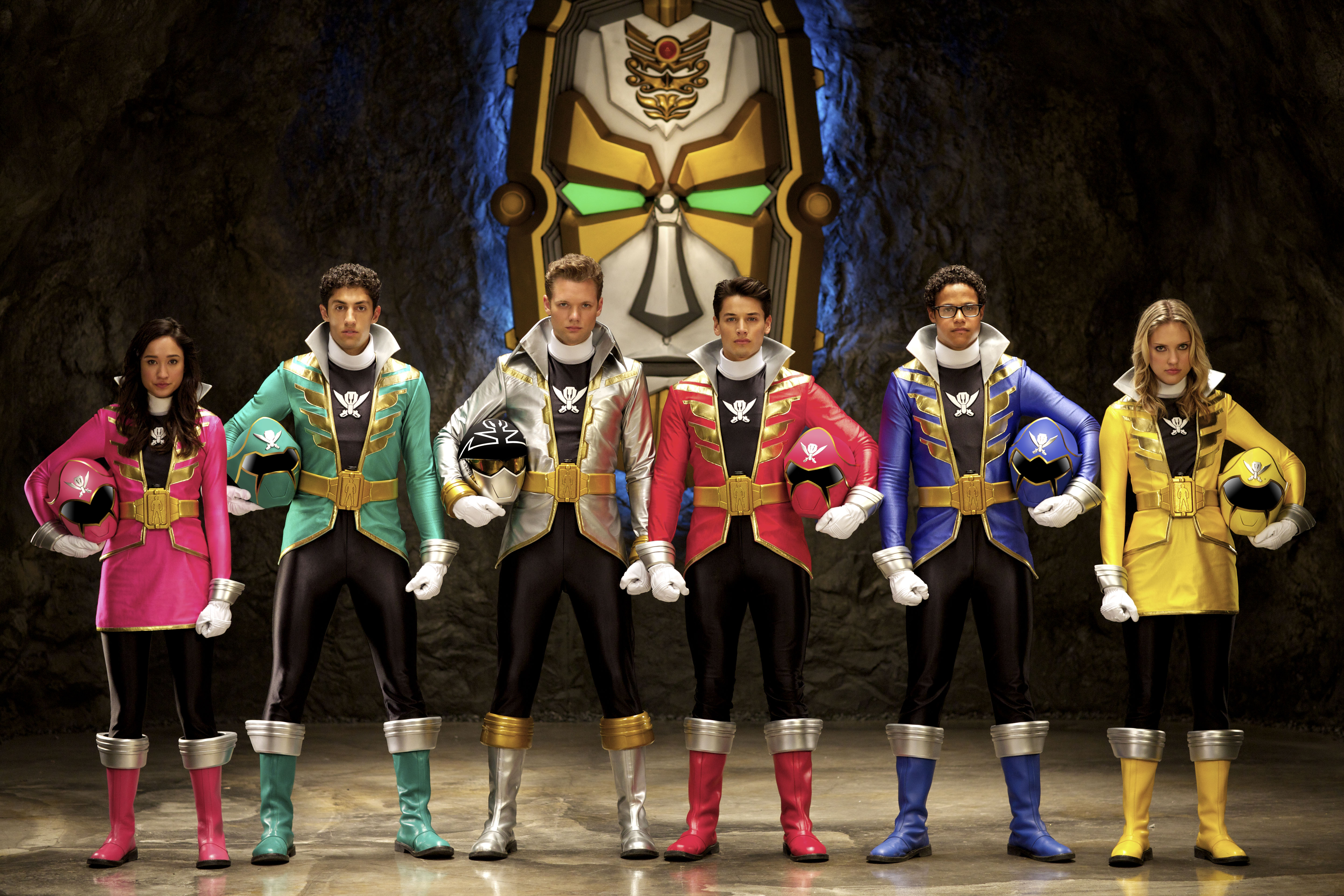
Now we come to the second half of this so called anniversary: Super MegaForce and once again, I'm not a fan of it. Coming off the boredom and bad writing of the first half, you'd think they'd have learned their lesson and improved. Unfortunately they didn't and it still feels as hollow as the first half while being just as infuriatingly boring. Since I don't count this as being a new season, the overall score will be given with the MegaForce half factored in.
Characters:
I'm not even going to bother calling them characters. It feels like they're just there to provide bodies for the suits. They don't feel like people, they feel like cardboard cut-outs. We know virtually nothing about any of them. Troy is the worst of them both in terms of acting (though he did improve a bit) and characterization. Orion is honestly the best of the rangers because he at the very least has a back-story and we learn things about him, even if it is very small stuff. Roboknight's final moments got no reaction from me whatsoever. The writers didn't bother to make the audience care for Roboknight in the first half which is a problem since he ended up being a major plot-point.
Gosei and Tensou are meant to be the Zordon and Alpha of this season. They are some of the most useless characters I've seen in the franchise. They don't add anything to the show, they're not comic relief and we never learn anything about them beyond their original introduction. All they do is sit around the command center. They are nothing more than set pieces. Gosei is hands down my least favorite mentor because he doesn't do much of anything. He is just a head on a wall so he can't move which means all he can do is give advice but he doesn't even do that most of the time. All he basically does is tell the rangers that they've learned something (the lesson often feels like a small one due to execution) and give out mecha like Halloween candy.

Writing: Oh boy, the writing didn't get much better compared to the first half. The exact same issues that plagued the first half still plague Super MegaForce. In addition to talking down to audience with extremely obvious messages, this half presents the audience with a lack of explanation (I'll get more into that in another section) and logical gaps that far too big for the audience to just go with it. It is ridiculous to expect the audience to fill in the gaps simply because the show doesn't want to. I don't expect Triple A writing from Power Rangers, I just expect decent/tolerable writing and for the show to at least try.

The love story between Gia and Jake hasn't been touched upon very much but it supposed to be one of the most memorable traits about Jake. They missed a major opportunity bring it to the fore-front in the episode "Emperor Mavro". They could've had Gia get kidnapped by Damarus instead of Troy since they had to reshot the entire scene anyway because Marvelous was un-transformed in the Gokaiger episode. It would've made more sense to have Gia be the one getting captured because it would've made the fight all the more personal for Jake. They didn't need to completely adapt the episode by having Troy get captured for one simple reason: Marvelous was captured in Gokaiger to draw out the Gokaigers while Troy was captured so they could make an example out of him to force Earth to surrender. Any of the Megaforce rangers would fit the bill for that job so why just use Troy when you could kill effectively kill two birds with one stone by using the situation to develop both Gia and Jake? But as is par for the course for Megaforce/Super Megaforce, it was a straight-up copy and paste of the Sentai episode because it was the cheapest route. Needless to say, it gets resolved in the finale and doesn't feel very convincing at all.

Acting: I have nothing against the cast overall. They gave it their best shot with what they were working with. Gia, Jake, Noah, and Orion are decent actors by PR standards. The mind swap episode sort of highlights Noah's ability to play the cool guy. He had this air of coolness about him when he was acting like Jake. Jake's nerdiness could've used some work though but I mostly blame the script for that since he was just essentially using bigger words to highlight that he was acting like Noah. Emma has improved from the first half as she sounds less cheery during the more serious moments of the show. Troy has improved a bit as well, he still has that slight monotone in his voice when reading his lines but he got a little more believable, minus the Nolan Batman yell in Vrak Is Back Part 2 of course. Again its just a little improvement but I will give credit where credit is due. Voice acting-wise, Roboknight is still well...Roboknight. He is still just a monotone robot which makes it hard to connect with his character.

Worst episodes: This award actually goes to two episodes, those being the episodes Blue Saber Saga and Tensou Alone. As I said in the mid-season review, the Blue Saber Saga is the most out of character thing I've seen in this show. There was absolutely no attempt to make it fit Noah's character. It was made entirely on the idea of adapting the episode completely intact. It makes absolutely no sense for someone like Noah to get depressed over losing a sword fight.
Tensou Alone is an original episode and its an amnesia episode. I'm a bit curious as to who thought this episode was a good idea. The episode was completely pointless. It didn't move the characters forward and it didn't move the plot forward. Most of it was just the rangers running around the city looking for Tensou because of a gag about him being mistaken for a suit case. It wasn't funny, it wasn't creative, and it certainly wasn't tense. In other words: This episode didn't need to exist. It was a waste of an episode and was only there to pad out the episode count.

Best episode: The best episode in Super Megaforce is still the Jungle Fury tribute. Which is sort of weird for me to admit since I don't particularly care for Jungle Fury. While the episode was ok, it did stick to continuity with Casey for the most part. It was another copy/paste episode but it worked out better than the Blue Saber Saga.

Villains: The Armada isn't much better than the villains from the first half. Vekar was a weird case for me. In the first episode of Super Megaforce, he had this sort of intimidating regal tone to his voice, but for some reason he just became a whiny little brat. Argus is just there to be the big brute and there is literally nothing memorable about him. When they died all I could think was "Well...that was a thing".
Vrak returns and that was a big mistake since Vrak barely did anything at all yet they built him up to be so important. I have no idea why they just didn't kill him off at the end of the first half. His plan for Roboknight makes no sense. How does he know how the ranger's powers work? How does he know how to corrupt that power? And more importantly how does draining Orion's life-force disable Super Mega Mode for the others? He'd have to be the physical incarnation of the morphing grid for that to even remotely make sense. These aren't just minor details since his entire plan is contingent on them. If draining a ranger's life-force/powers affected their teammates powers then the Mighty Morphin' rangers would've been affected by the green candle's magic as well and Rita wouldn't have needed separate candles for each ranger.

Pre-Zyu Suits:
I'm aggravated that they're here with absolutely no explanation. They clearly aren't going to make toys out of them otherwise it would've been big news. They could've been used for world building but they weren't. We have no clue where they came from other than the "Never before seen on Earth" line. Heck, "Never before see on Earth" could mean any number of things other than being from space, like powers held in reserve, powers stockpiled but never used. All they needed was a small line that roughly said "These powers are from other planets". They missed a major opportunity to expand the PR mythos. They're presumably not even in the archives Noah got from Gosei.

None of the Lightspeed Rescue keys got used outside of the episode Legendary Battle (extended version only) and yet we got suits that are here for no real reason other than to save money on editing. They even went so far as to name the new modes but it becomes a moot point since we know nothing about these teams or where they came from. If you're going to make this things canon then at least give them some sort of origin. Its little details and explanations like that that show you're passionate about what you do and that you take pride in it. Its really bad when the fans have to come up with explanations that you're too lazy to give. It is disrespectful to your target audience, disrespectful to the older fans, and above all it is disrespectful to the franchise as a whole.

Logical Gaps: As I said earlier in the review, the show leaves a lot of gaps that either contradict themselves, don't make sense in general, or that the show just hand waves away. Since I've already covered some of them in other sections, I'll just talk about a few of the others here. The existence of Roboknight's key is one of them. The show never really explains whether the keys are the actual powers or if they are simply borrowing/copying the powers. Either way Roboknight's key shouldn't exist in Super Megaforce for the simple reason that the powers were still in use at the time which begs the question as to how it shows up in Orion's Gold Mode. The Roboknight key gets introduced as a way to simply to track his life-force. It tied into a key plot-point so why wasn't it introduced earlier to at least show proof to the other rangers that Roboknight was sort of ok before now. There is no explanation for why Orion can combine the keys other than Gosei saying "he has the potential" which is the show hand-waving the issue away by saying he just can.

Legendary Battle: Since there were two separate versions of the finale, I'll talk about both and start with the regular version.
The opening cameos from the legendary rangers were the best part of the episode. Those scenes actually felt like a Power Rangers show, especially seeing Carter and Dana running through the rubble to rescue people. The rest of the episode however was very underwhelming and just a mess in terms of pacing. Mavro and his goons die off far too easily so all the legendary rangers are basically doing is mopping up the remaining x-borgs. Seems a bit of a waste of the legendary rangers and all the ranger suits. It would've been more effective to have Mavro survive his ship exploding and send the x-borgs as well as himself into the battle. That way the legendary rangers could clear the x-borgs out of the way so the Megaforce rangers could finish Mavro. I have no idea why they opted to air this version on their main channel instead of the extended version. It would've made it feel less rushed. It was boring and poorly handled. That is the biggest problem with this episode since it was promoted/teased/promised for two years.

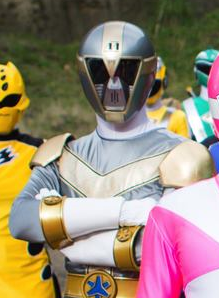
The scene where the Legendary rangers pose on the cliff was a bit inconsistent. Tommy's forms didn't appear with their teams since he was present with the green ranger powers and because he held multiple powers. However, the red and pink turbo rangers were with the turbo rangers despite TJ and Cassie being present with their In Space powers. Lightspeed red and pink also appeared with their team but I'll cut them some slack since no one from that team or Lost Galaxy held other powers. Roboknight somehow shows up despite being dead with no explanation given for how he is back. He also isn't shown in the group shot of all the rangers. If I had to pick something that visibly highlighted the laziness over the last two years, it would be the Titanium ranger's helmet during the Legendary Battle episode. The visor is on backwards and no one caught that. You can even see the mouth piece.
Seriously, how did no one catch this?
The extended version isn't much better and they did exactly what I thought they'd do. Half of the 54 minute run-time is because they combined the Legendary Battle episode with The Wrath. The combination helped out the pacing to some degree but I don't really count that as being part of the extended version since nothing was added to The Wrath. All they basically did in the Legendary Battle part was give Tommy a few more lines when he was saving the kid in the car and add the key shifting sequence from Gokaiger's finale. However, they did manage to limit the sequence to only the PR teams. They also referenced Karone's past by having her face shift to Astronema's before she put the helmet on. The extended version is better paced than the regular version but that is about it.

Now this wasn't part of the episode but its more an issue I have with the trailer for it so I feel it is worth mentioning. The trailer that aired prior to the finale on Nickelodean called Tommy "the Ultimate Power" of the Power Rangers. While I don't mind Tommy as a character, I feel I should point out that Tommy only got to where he is now because he had his team behind him. It felt sort of like they slapped the other veterans in the face with that trailer. I understand that he is the most popular ranger in the franchise and has come back many times but it felt unnecessary since he wasn't the only one to come back.

Final thoughts: I've been with the franchise since the beginning and this "anniversary" did the unthinkable, it made me question why I've watched it all these years. This doesn't even feel like an anniversary. It has some cheese here and there but none of the heart. It doesn't even feel like Power Rangers and therein lies my problem with the Neo Saban era as a whole. They're making shows that look and sound like Power Rangers but they lack the heart and what makes it Power Rangers while making references to the franchise as a whole. As flawed as Overdrive and Turbo were, they at least felt like Power Rangers. An anniversary is meant to showcase what makes a franchise special and show how far its come since it began. It should instill a sense of pride in members of the fandom both old and new. It is how you pay your audience back for all the years of loyalty.
In my mind, there are two ways to tick your audience off: 1. You can try an idea and not properly execute it in which case you'll end up with a badly executed show but at least you tried. 2. You can play it safe and do nothing at all, in which case you'll end up with a lazily written show with poor execution. MegaForce/Super Megaforce is clearly the latter. For all the trash people talk about Overdrive and Turbo, at least they tried to be entertaining. MegaForce is a show that feels like nothing...just nothing. It tried too hard to play it safe and ending up shooting itself in the foot. I'd much rather be angry at a show for being bad than be angry at it for being boring. The show relies on so many logical gaps for everything to work. Yeah, I have never denied that PR is a kids show but even kids shows need their own logic for why things work the way they do. When stuff doesn't make sense they need to explain things otherwise they just create plot-holes. It feels sort of like the show has a vendetta against explaining itself. As far as I'm concerned Megaforce/Super Megaforce have earned their spot as the worst season in the franchise, because its not just bad, it is a big old cup of boring (which is arguably worse than being bad), and refuses to try something. I give both halves a collective score of 2 out of 10 and the distinction of worst season in the franchise. This show was exhausting (not in the good way), infuriating, and it felt like a punch in the stomach. I really hope Dino Charge is better.

Tuesday, December 2, 2014

Toqger : a review, and why that show sucks.

38 episodes of Toqger have aired now, which means there are only about 10 episode left, and it's possible to make a review of most of the series now.
Let's just say that Toqger is likely one of the worst sentai ever made, because it suffers of massive flaws in most elements of the show :

- Heroes : the five main heroes are some of the blandest main characters I've seen in sentai. They don't show much depth, Right being the hot blooded one, Tokatti, the clumsy one, Mio the "big sister" one, Hikari the serious one and Kagura the cure ditzy one. Other than that, most the the episodes trying to focus on them individually are pretty much using stock plots which aren't giving them much personality and background. Of course, it's explained by the fact they're just overgrown kids who are in adult bodies, but still have children's minds. But it's precisely why the concept doesn't really work for the characters, since it makes them feel  pretty bland and doesn't allow much development. Besides, they pretty much share a common background ; so not much room for exploration.
Akira, the sixth ranger, is a Shadow who, because of remorse for his past actions, has ljoined the Rainbow line to atone for his "crimes" (basically, making rain, which isn't really THAT horrible as a crime), and eventually becomes the sixth Toqger because of Right. However, as Akira, he isn't very interesting, and his catchphrase " my death place" is pretty annoying. While he can show some comedy because of his ridiculously serious expression, it doesn't really make him striking. His only potentialy interesting plot is his relationship with Schwartz, especially after the latter becomes also a traitor in the Shadow Line's eyes.

Allies : It's pretty telling when the smartest character in the show is a monkey puppet.  and even despite this, Ticket is usually annoying with its grating voice. And the less we talk about the Conductor, Wagon, or the president of the Rainbow line and his bunny head, the better.

Villains : they're the most interesting characters of the show and even despite that, they're pretty uneven. The most interesting element with the Shadow line is how dyfunctional the villain group is, with most of the villains having an antagonism against the others. Another good point about the Shadow Line is that the generals are skilled fighters, and that they regularly show it.
Mork and Nero are the least interesting of the Shadow Line, merely standard generals who mostly care about spreading darkness. Madame Noire is most interesting, because she tried to take over the Shadow Line by using her daughter Gritta to marry and then "eat" the Emperor of the Shadow Line, Zet. Unfortunately for her, her plan backfired, and since then, she's pretty much forced to work for Zet, her only hope to break free being the fact that her daughter might not have been completely consumed by the emperor. However, that concern about her daughter isn't consistent with  the fact she used her as a tool to get power.
Gritta, Noire's daughter is interesting because she hasn't shown much evil, and she showed loving feelings for General Schwartz. However, despite not wanting to marry the emperor, she was forced to do so after failing to run away, because of Noire's insistence and Schwartz's betrayal. After eating Emperor Zet, she briefly became Empress of Shadow, but at the end, Zet ended up taking over her, and now, she's stuck into the Emperor's body. Gritta has some potential, because she's more innocent than evil but she needs more screen time.
Schwartz and Zet are the most interesting characters. Zet, despite being the Emperor of Darkness, doesn't care about his generals, monsters and spreading darkness, but only is obsessed about light, shining, and spends most of the time being bored. While he's supposed to be the Big Bad, and even if he's not especially nice, and has shown impressive amounts of power, he doesn't seem to care anough to feel really like a Big Bad. It has some potential as a story, but unfortunately, it also adds to the stalling of the plot.
Schwartz is more interesting : he's pretty much an outcast among the Shadow, because, rather than darkness, he's more interested by military conquest using war trains. He's a cunning and cruel general, but he's also shown an honorable side. While he ended up betraying Gritta, because he hoped that by helping Madame Noire in her usurping plot, he would be allowed to have his army and conquer the world using his trains and soldiers, he was still touched by Miss Gritta's feelings for her, and when the young girl sacrificed herself to save him from a Toqger attack, and ended up being taken over by Zet, Schwartz started to feel genuine remorse in what his action did to the young girl, and, after being banished by Zet, wanted to avenge himself and Gritta to find some redemption.
As such, his relationship with Akira/ Zaram might be interesting to see, given both are driven by remorse now.

Plot : The Toqger, who are actually kids who managed to escape a town ovetaken by darkness thansk to their imagination ended up grown up by the president of the Rainbow Line and now fight the e Shadow Line, using the power of Imagination and are looking for their home city.
While the concept isn't that bad, unfortunately the execution is pretty badly done, notably because og Kobayashi is very poorly talented in storytelling, once again. Indeed, the heroes are only likely to find their hometown in the final episodes, which means that there still need to find some plot for the middle episodes. While there has been some nice elements, with important plots being forshadowed in previous episodes, Toqger still suffers from plot stalling.
During the first 10 episodes, , except a showdown with Schwartz, pretty much nothing happens, except some standard plots involving Shadow Monsters. While episodes 11 and 12 introduce the Emperor, and  the heroes meet at last most of the main villains, it doesn't really raises the stakes for the heroes, notably because of the lack of leadership from Zet. The introduction of the sixth ranger Akira isn't done in very memorable episodes, and at the end, the next really significant arc happens during episodes 22 and 23, with the "Noire's usurping plot with Gritta marrying Zet" with a big showdown opposing  the heroes in one side, and Schwartz and a newly empress Gritta on the other side. At the end, Zet overtakes Gritta, banishes Schwartz and pretty much tames Noire. However, after episode 23, the plot pretty much stalls, with nothing really significant happening during the next 15 episodes. The arrival of the new villainess, Mork, doesn't change much in the statu quo, the appearance of the Hyper Mode, and the new mechas (the Hyper Terminal notably) aren't really well done, since they're done in individual episodes, which almost feel like fillers, with silly monsters  : a very striking element is how in those key episodes, the villains are more fighting each other than are fighting the heroes. In fact, in episode 35, with the appearance of the Toqrainbow, the biggest robot, the heroes are more saved by Zet's unpredictable character and Schwartz's dealing with Akira than by their own power . Another wasted opportunity is the use of the Shadow Towns, overtaken by the Shadow Line and guarded by Overseers which have a chess theme. What should have been key episodes ended up being written pretty much as fillers.
A key element is also the lack of rivalry between heroes and villains : Right's rivalry with Zet doesn't feel right, because Zet cares too little about darkness and taking over the world to feel like a worthy enemy to hate. Besides, as it was said before, the real rivalries the Shadow Line generals have are more between each other than against the heroes. Sometimes, the heroes feel like they are the guest stars of their own show. Because of that, there is a lack of intensity in the conflicts, and it's hard to care for them. Moreover, because of the blandness of the heroes, it's also hard to realy care for them and their quest; heck, even the reveals they're overgrown kids feels like "yes, so what"? ; notably because the show fails to use that background in a really dramatic effect in most of the show, and the reveal doesn't really change anything for the heroes.Because of how bland they are, it's difficult to really care for the heroes. As said before, it's a similar situation that Go-Busters had : a long running plot that is pretty much bound to stall most of the series; it's interesting that Go-Busters had to deal with its main plot midway, because the show stalled too much. Here, a similar plot (children looking for their parents who are stuck in a place overtaken by evil) is still ongoing.

The train gimmick isn't badly done, but the "Norikae changes" gimmick  where the heroes change colors is usually more cofusing than interesting (no wonder he's less used in late episodes). The mechas's design are okay but not remarkable, and some robots are pretty much too "clusterfuck", especially Toqrainbow.

To sum up, Toqger suffers a lot from its bland heroes and supporting characters, a very mediocre storytelling with main plots which stalls too long, uneven villains, and a lack of imagination shown by the excessive use of stock plot in individual episodes, which is ridiculous because of how much imagination is supposed to be a major theme, and as such, is likely one of the worst sentai show ever made.

Your thoughts?

Additional thoughts, after the Christmas arc :
I had high hopes for that arc, especially since it would at last change the statu quo, and bring the climax of several subplots started in previous episodes, Gritta still alive inside Zett, Schwartz's rebellion and quest to save Gritta, Noire's plot to get back her daughter, and, more importantly, Akira leaving the Shadow Line to join Schwartz.
To be fair, I must admit that those subplots weren't that badly done : indeed, Schwartz and Noire free Gritta from Zett's body, and Schwartz learns what it means to fight for the sake of others : his character development is nicely done, and his sacrifice is moving : it was a nice symbol to see his eyes shine before his death, thesymbol of finding the "Kira Kira" that Zett is so obsessed with. The interactions between Akira/Zaram and Schwartz alos show how much those two were similar and kindred souls before Zatram's betrayal, and the irony of Schwartz becoming like Zaram is nice to see. Oh, and Zett becoming Toq6go was fun too.
Unfortunately, as a whole, I felt that that Christmas arc was not very good, for several reasons :

- first, it tries too much to make us see Zett as that horrible villain, even if in truth, all he wanted to do is to be left alone, and that he's never the one who attacks first : most of his actions are in self defense, and while he had Gritta in him, he didn't want Mork and Nero to attack her. Moreover, interestingly, he almost only fights his fellow Shadow Line generals, only attacking Right when the latter prevented him to kill Zaram/Akira, even if in truth, Zett was in self-defense situation. Even if Zett indeed kills Noire and Schwartz, he's completely justified to do so, since both wanted to take his life. Moreover, the show wants us to feel sorry for Noire while she was using her daughter as a tool for her ambitions : I never felt any real selflessness in her actions, unlike Schwartz's.

- second, the Toqgers themselves : I've never seen a situation where the main heroes of the show were so sidelined : they felt like guest stars in their own story : most of the climactic moments involved internal fighting within the Shadow Line, and it's significant that in most of the arc, Akira appeared as his Zaram guise. I really felt like the Toqgers were more witnesses than anything else, which is absolutely ridiculous in such shows. The final robot battle was completely devoid of any thrill, because despite the huge number of Kurainers to destroy, it was obvious that that outburst had absolutely no direction : I felt nothing during the big robot fight because all the climactic moments happened before.

- third, I feel that by resolving the Schwartz plot too early, the show missed the opportunity to put Akira in a more difficult situation where he would be forced to fight his friends, since during that whole arc, Akira and the others Toqger weren't really on opposite sides (Even Akira said so). While it's touching to see Akira realize how much the Toqger care for him, at the end, the show carefully avoided a potentially interesting plot.

- Fourth, am I the only one to feel that Mork and Nero are completely irrelevant characters? They pretty did nothing really meaningful in that arc, and were as sidelined as the Toqger : such a waste

As such, that Christmas plot once again highlighted the big flaws of Toqger as well as its few good points as well.

Thursday, November 6, 2014

Machineman and Byclossers : when Ishinomori and Takaku try to do Metal Hero outside the official franchise

The first half of the 80' saw the beginning of an incredibly popular franchise : the Metal Hero franchise, with the Space Sheriff shows. Because of their popularity, Shoutaro Ishinomori, creator of Kamen Rider, Kikaider and Gorenger, who didn't have any rights over the Metal hero franchise (the official producer was Yatsude Saburo (Toei's staff) tried to create shows trying to get a similar vibe. As such, two shows were produced: in 1984, Seiun Kamen Machineman which had some elements similar to the Metal Hero franchise while still having its own personality, and in 1985, Kyyodai Ken Byclossers, which was pretty much an unofficial Metal Hero show. Both shows shared a same main writer: Susumu Takaku. Both shows have many similar elements despite a different premise. Moreover, those shows are gonna have an influence in later shows written by the writing staff involved.

1) Machineman and Byclossers : an overview

1-1) Machineman

Seiun Kamen Machineman, a 36 episodes long series produced in 1984, tells the story of a young alien student coming from the Ivy planet in the  Pleiades constellation who comes to Earth to study it and its inhabitants for his university thesis. He went on Earth in a spaceship which is then hidden on a lake, and then, starts to live on Earth as Ken Takase, a young clumsy man with glasses. While visiting Earth, he meets a young journalist and photographer, Maki Hayama (played by Kiyomi Tsukada, who would play Anri, Juspion's android companion a year later), who is investigating the misdeeds of a criminal organization named Tentacle. Very soon, Maki ends up being threatened by the evil group, and Ken ends up rescuing her by fighting Tentacle, by changing into a masked, caped and armored suit, using a special device and his personal vehicle, Dolphin. After learning of Tentacle, he decides to stay on Earth to fight the evil organization, helped by his faithful companion, Ballboy, a little robot which looks like a baseball ball.
Tentacle, which especially focus on crimes against children has as a leader Professor K (played by Hideyo Amamoto, who played Dr Shinigami in the original Kamen Rider series), a man who hates children because he's allergic to them. Professor K is  helped by his right hand robot Ironman Mons, as well as other robots and men he has corrupted.
Halfway through the series, Tentacle is dismantled after Machineman defeats Ironman Mons and Professor K goes into hiding, but then, a new criminal organization replaces it : Octopus, led by Lady M (played by Chiaki Kojo, who played Keller in Denziman), professor K's niece , who is helped by her bumbling sidekick TonChinkan, as well as other robots and corrupted humans, and who hates as much children as her uncle. In the final arc, both K and M join forces for a final showdown against Machineman. After his victory, Machineman comes back in his planet, having done a good study of Earth, and confident that peace is back.
An interesting element of Machineman is the fact that the hero has to fight both robots and corrupted humans, and while he destroys the robot in a typical  explosive way, he deals with the corrupted humans by leaving a M mark with his sword and then, uses a wave to purge them from their evil, defeating them without killing them.

1-2) Kyodai Ken Byclossers


Kyodai Ken Byclossers, a 34 episode long series produced in 1985, tells the story of two young brothers who lives with their parents, Ken and Ginjiro Mizuno, , who, one day , see a mysterious light on the sky, and while investigation it, end up encountering the members of a criminal organization, Dester. Chased by the villains, they almost die, but are saved by a mysterious spaceship. While on the spaceship, a mysterious voice coming from outer space tells them that they are the heroes chosen to become the Bycrossers. Ken becomes the red-and-white-armored Bycrosser Ken and Ginjiro becomes the blue-and-red armored Bycrosser Gin.
Together, they fight the evil organization Dester, led by Doctor Q (played by Kenji Ushio, the original actor playing Hedder in Battle Fever, before being replaced by Masashi Ishibashi) and her female assistant, Sylvia. Their plan involve using evil robots and mooks to make suffer children, because their screams and crying make a mysterious idol, the Majin Gora, create jewels.
Whenever Dester has an evil plan, the Bycrossers investigate it and then, thwarts it and destroy the robots, with a final move involving both brothers, Ken who is using a cannon formed from the motorcycle piloted by Gin.
Midway through the show, Gora ends up becoming more than a mere idol, and shows his real appearance of an evil God, Gorazonger. Gorazonger soon becomes the leader of Dester, and starts his plans of world conquest, helped by Dr Q, Sylvia and a new female sidekick, Rita, who soons becomes the rival of Sylvia.
At the end, the Bycrosser confronts Dester once and for all: they destroy Gorazonger, and Dr Q and his two female companions end up as fugitives in the desert.


2) Machineman and Byclosser : two shows of the 80's with the Metal Hero influence.

Machineman and Byclosser are both very episodic shows, and most episodes tell a full story. The overall story only goes forward in few instances, notably when theere are big changes on the villain side, and of course, in the final showdown. As 80' shows, they are of course influenced by the successful tokusatsu shows of their era, especially the Metal Hero shows.

Machineman indeed shows some Metal Hero elements : the transforming sequences involving the hero's ship and the sequence with the hero being illuminated by light particles while doing his henshin moves. Moreover, the final move involves a light saver similar to the Laser Blade of the Space Sheriff. Besides, he's also an alien disguised as a normal human. Interestingly, the suit, with a mask only covering the upper part of the face is similar to ... Riderman.
However, Machineman's main influence seems more to be ... Superman. Indeed, the hero is an alien whose superpowers comes from his extraterrestrial origin,  who has an alter ego who is a bumbling man with glasses. The female lead is a young journalist who loves investigating and ends up being in danger because of that ... pretty much like Lois Lane.

Byclossers, however, has more similarities with the Metal Hero franchise. Indeed, the brothers's suit are very similar to Metal Hero armors, the design being a mix of a sentai suit, a Space Sheriff suit and the suit which would be used later in Metalder and Janperson. Their concepts are similar, with the evil organization being similar to Maku, Madou and Fuma, and, like a classic Metal Hero, change thanks to a ray coming from their main ship. Like most Metal Hero shows, there is a focus on the vehicles used by the heroes, with plenty of stock footage. Lastly the basic structur of an episode is pretty similar to a typical Space Sheriff show, endign with a climactic battle with the Monster of the Week.

3) Similarities between Machineman and Byclossers

Machineman and Byclossers have a lot of common elements :

- Both are very episodic shows: most episodes are a full standalon story, involving the villain starting a plan, the hero(es) discovering and investigating the plan, and stopping it.
- Both have the heroes having their powers from outer space: Machineman is himslef an alien while the Byclossers get their powers from aliens from a faraway planet.
- Both detect people in distress thanks to superpowered senses: Machineman's surhuman hearing and Byclossers's telepathic powers).
-Both have major villains named after letter: Professor K and Lady M from Machineman, and Doctor Q from Byclossers (all are sendbacks from Doctor G from Kamen Rider V3)
- Both shows have major changes midway, especially in the villain side : in Machineman, Tentacle is replaced by Octopus, and in Byclossers, the idol Gora ends up becoming the evil god Gorazonger, and becomes the leader of Dester, with Rita coming along at the same time. Moreover, in Byclossers, at the same time, the heroes start living by themselves.
- Both shows involve children a lot : chikd characters are regulars in both shows
- Both shows have the evil group focusing on making children suffer, either because of their hatred for children (Machineman), or for greed (Byclossers)
- Both shows have major villains showing immature behaviour, being pretty childish themselves, especially the female ones like Machineman's Lady M or Byclosser's Sylvia and Rita.
- Interestingly, in both shows the human looking villain survive at the end as fugitives.
- Because of all those elements, both shows are pretty light hearted and targeted to a kid audience.

4) Machineman and Byclosser : a similar writing team and influence on later shows

A lot of the similarities between both shows can be also explaned by the fact they're both shows of the 80', where tokusatsu started being less violent than in the 70', and more light hearted, and because they share a same staff, notably a same writing staff. Both shows have Susumu Takaku as main writer.

Here are the writers for both shows

Machineman (36 episodes)

Susumu Takaku (main writer) : 4-5, 7-10, 12, 14, 16-17, 19-20, 22-23, 27 (with Tatsuro Nagai), 30, 32-33 (18 episodes)
Shouzo Uehara : 1-2 (with his real name)  3, 6 (under the  pen name Keita Izumizaki) 11, 34-36 (under the pen name Hikaru Kihara) (8 episodes in total)
Noboru Sugimura : 13, 18, 21, 24, 26, 28-29, 31 (8 episodes)
Atsuko Osoya : 15 (1 episode)
Isao Matsumoto : 25 (1 episode)
Tatsuro Nagai : 27 (with Takaku) (1 episode)


Byclosser (34 episodes)

Susumu Takaku (main writer): 1-7, 9-10, 13-15, 19, 22 (with Tatsuro Nagai), 26, 29, 32 (with Nagai), 33-34 (19 episodes)
Rumiko Asao : 8, 12, 25, 30 (4 episodes)
Kyoko Sagiyama : 11, 18, 24 (3 episodes)
Noboru Sugimura : 16-17, 21, 27, 31 (5 episodes)
Shigeru Sato : 20, 23, 28 (3 episodes)
Tatsuro Nagai : 22, 32 (both with Takaku)

Susumu Takaku is the main writer of both shows. Interestingly, in Machineman, Shouzo Uehara is a major secondary writer, who wrote both the first three and last three episode (episode 36 is a recap). Takaku and Uehara have both been involved in early sentai shows, and both have been the two major writers of Battle Fever. Takaku has also been a seconday writer of Uehara in his sentai shows, as well as the two first Space Sheriff shows, notably Sharivan. As such, the episodic element of those shows is very similar to those previous tokusatsu show, with the focus on children having started in shows like Sun Vulcan and the Space Sheriff shows. It's obvious that Uehara and Takaku's involvement in Machineman has helped giving the Metal Hero vibe.
However the main element of both those shows are that the heroes aren't part of a professional team, but are independant heroes trying to live an ordinary daily life, an element seen a lot in more recent toku shows.
In Byclosser, Uehara is not involved, and Takaku is the one who handles all the major arc episodes, including the intro episodes and the final arc. Takaku still uses the episodic writing used in the previous shows. Moreover, Dester is pretty similar to the evil groups seen in previous shows involving Takaku, such as the Egos group from Battle Fever, or Madou from Sharivan.
A amjor secondary writer is involved in both shows: Noboru Sugimura. At the time, Sugimura was starting writing in tokusatsu, and he's been involved a lot with Takaku, as secondary writer of his shows, and then Takaku becoming a major secondary writer of the shows written by Sugimura.
It's interesting to notice how much Sugimura took from these two shows in those he would write later : indeed, the bumbling police team of Jiban isn't unlike the newpaper team seen in Machineman, with the female lead being the most reasonable character. Another Machineman element : the hero changes in his vehicle, like in Winspector and Solbrain later. Another Rescue Police element : villains are often ordinary people who are criminals.  But, more importantly, the show which has the most elements coming from Machineman and Byclosser is of course Zyuranger : indeed, Zyuranger has a special focus on children, has evildoers especially focused on making children suffer, but also show an immature and comical side. The tone seen in Zyuranger isn't unlike the one seen in Machineman and Bycrosser, and like in Zyuranger, most villain survive.
The over the top feeling seen in Machineman, and especially Byclosser would be also seen in Sugimura's other sentai shows, like Kakuranger.

Your thoughts?


Monday, November 3, 2014

Space Sheriff shows : some random thoughts


1) Space Sheriffs shows : similarities with early sentai shows.

In 1982, Uchuu Keji Gavan (Space Sheriff Gavan) aired in Japan, starting the Metal Hero franchise, which would last until the late 90'. The first series of that franchise were the shows called the "Space Sheriff" trilogy : Gavan, Sharivan and Shaider, which involved a hero linked to an intergalactic police force. All three shows had a basic plot : an evil organization which had already destroyed several planets and civilizations start to threaten Earth, trying to conquer it (Makuu in Gavan, Madou in Sharivan and Fuuma in Shaider), and the Universe police, based on Planet Bird, send a new officer, helped by a female assistant to thwart their evil plans and protect Earth.

However, despite the heroes being called Space Sheriffs, the shows didn't really have a "cop show feeling". Gavan, Sharivan and Shaider were mostly episodic shows with a few long running arcs which had their climax in the final episodes of the show. The explanation of that relative lack of "cop show" feeling can be explained by the fact the heroes are acting pretty much  incognito on Earth, looking like civilians to most citizens of Earth.
Most of the episodes involved a plot from the villains to conquer and submit humanity using a Monster of the week, often involving disruption of society, and the hero would find about that plot, and then, face the evil group and defeat the monster of the week involved in a final climactic battle in an evil dimensions where the monster would be stronger. In a lot of cases, the hero would find about the plot by meeting a civilian who ended up caught in the plot, or who has someone close to him caught in it ; in the latter case, the civilian is often a kid.

Space Sheriff shows are very formulaic : each episode include scenes in the villain's lair where the evil plot of the week is explained, the first part of the episode has its storyline centered about the plot, showing civilains caught in the plot and the hero investigating, with often a first fight against the enemies, and the Monster of the week. The last minutes of the episode include the climactic fight, a short first part in the normal universe where the heroes fight the monsters, mooks and the main generals, and then, most of the showdown between the Monster of the Week and the hero in his metal suit in a special dimension, showing strange visual effects (visually, it looks like something coming from hallucinations). To get into the special dimension, the hero would use his motorcycle. The enemy would also send a big flying war machine to attack the hero, and also flying jets, and the hero uses his special big spaceship to destroy the enemy ships and aircraft. At the end, the hero kills the monster using his Laser Blade. A short final scene concludes the episode, concluding by a short narration.

Sounds familiar? No wonder : those plots are incredibly similar to those of early sentai shows, notably Battle Fever, Denziman and Sun Vulcan. Even if in the first case, the shows involve a group of heroes when the Metal Hero shows only involve an unique one, the plots of the individual episodes aren't that different from plots from sentai episodes. It can be easily explained by the fact that the creative team between the early sentai shows and the Space Sheriff shows is pretty much the same with Shouzo Uehara as main writer and Susumu Yoshikawa as main producer (and the star of the first show, Kenji Ohba has played a sentai member in both Battle Fever and Denziman (Battle Kenya and Denziblue)) . The shows involving that team are often very episodic, and a lot of focus is given to the individual plots. The villains groups also have enemy groups taking a lot from early sentai villains : Fuuma, Madou and Maku have concepts pretty similar to the Vader clan. The Big Bad is a classic devil like entity (similar to Satan Egos from Battle Fever or most Toei Big Bads), and the generals also have their roots from early sentai shows :  in Gavan, Hunter Killer is a male general, who lead the plots and can also be involved in direct fights, like Denziman's General Hedrer, Poe from Shaider is an androgynous version of Hedder from Battle Fever, the Girl Army of Shaider are similar to the Zero Girls from Sun Vulcan. Interestingly, Dr Polter and General Gyrer from Sharivan are similar to Deathgiller and Mazurka from Goggle V, even if that sentai show was the first one not involving Uehara, while stil having the influence of the early Uehara shows.
Interestingly, while the Space Sheriff don't fight monsters in giant forms, they still use giant mechas in their fights to destroy enemy spaceships, and those are often transforming mechas with a robot like mode, like the Battle Formations from Sharivan's Grand Birth and Vavilos's Battle Formation. In the following show, Juspion (involving the same creative team), the sentai like element would be even stronger, given that time the show would include confrontation between giant monsters and the hero in a big robot.

Lastly, the long running plots often feel like space opera fantasy, with the hero trying to find his destiny and fulfill a quest: Gavan would search for his father, Sharivan would fight to save his native planet, looking for a mystical Crystal, and Shaider, as a former archeologist would find the secret of the mysterious Fuuma civilization, its links with the Nasca civilizations, as well as his own origins. Shairvan had the most detailed plot, with some recurring characters being fellow Iga planet survivors. Those fantasy elements take a lot from those seen in Denziman. The following shows involving Uehara and Yoshikawa would have similar fantasy elements, while being often more plot driven (Juspion especially has a "space opera feeling", especially with its early episodes happening in other planets, and Spielban also had a family drama not unlike Gavan). Gavan and Sharivan are especially interesting since Sharivan is the direct sequel of Gavan : the hero who would become Sharivan appeared in the final arc of Gavan, and Gavan is a major supporting character of Sharivan, as a mentor figure. As such, they show an huge world building involving several planets and universe and even more giving the "space opera" feeling when the shows (notably Sharivan) reach their main arc episodes. Shaider, while being in the same universe, has a more "standalone feeling", with Gavan and Sharivan not appearing in the main series, except a special episode.


2) Shaider : the assistant is the co-star.

Shaider, compared to its preceding Space Sheriff shows has a very distinctive element  ; it involves a very active assistant, Annie. While Gavan and Sharivan had also female assistants, (Gavan had Mimi, who could change into a bird, and Sharivan had Lilly), those ones were mostly staying in the base, and only very occasionally working on the battlefield with the hero. Ohba and Watari, Gavan and Sharivan were the undisputed stars of their shows. The episodes were follwoing Gavan and Sharivan in their investigation, often showing them involved in plenty of action, even without changing into their metal suits.
However, in Shaider, Annie was pretty much as much involved in the action as Shaider, at least before the final showdown between the suit hero and the monster. Several very interesting elements makes Annie very different from her predecessors :
-  her name : "Annie" is a real "first name" (a foreign one) and sounds much more serious than the cute "Mimi" and "Lilly" which are two repeated katakanas. (that use of serious names would be used again in Spielban, where the hero's assistant (later two assistants) have serious foreign names : Diana and then, Helen (the latter being the hero's sister and would also be played by Annie's actress, Naomi Morinaga)
- she also has her own song, which is regularly played during the show "Annie ni omakase" , which highlights her determination in fighting Fuuma
-she has her own car, a yellow one, and odten uses it to get into the action
- she is very involved in the action, having fight scenes in most episodes, and in many of them, she has even more out of suit fight than Shaider himself
- in the final narration, Annie is included  with Shaider, unlike her predecessors, more than ever confirming her status as a co-star.

An important explanation of that anomaly is linked to the actor playing the hero : Kenji Ohba and Hiroshi Watari were both actors with plenty of action experience, coming from the Japan Action Club, (Ohba has been a suit actor in sentai series, including those he starred in). As such, Gavan and Sharivan displayed a lot their main actor's action skills, with plenty of out of suit action. Moreover, both Ohba and Watari were charismatic actors and had no trouble carrying their shows on their own.
However, Shaider's actor, Hiroshi Tsuburaya (grandson of Eiji Tsuburaya, who was the creator of Ultraman and the one involved in the special effects of Godzilla (in a way Godzilla's creator)) had very little action experience and actign experience, and while he managed to hold his own in Shaider, he had neither the action skills or the charisma of Ohba and Watari. As such, the assistant character had her role being increased a lot, was played by Naomi Morinaga, an actress who had been involved in the Japan Action Club, and as such, could bring her fighting skills (and her good looks), while Shaider was mainly involved in the final climactic fight in the Fushigi dimension. Annie became soon very popular, even more than Shaider, and as such, was pretty much the co-star, being almost the equal of the main hero, while Mimi and Lilly had more limited supporting roles. While Mimi and Lilly were assistants to Gavan and Sharivan, Annie was more of a partner to Shaider, being very active. Very active supporting female characters would also appear in Spielban, with Diana and Helen, and in Jiban, where Yoko is also involved in a lot of the non suit action scenes as the "female cop with the gun".

3) Dekaranger : Arakawa's tribute to the Metal Hero Franchise, notably the Space Sheriff shows

Tokusou Sentai Dekaranger, the 28th sentai series has a police theme : the heroes are cops from a special police  force (SPD) involved in dealing with alien criminals. Dekaranger was a cop show sentai involving a intergalactic police force which has branches in plenty of planets in the universe, with the Dekaranger being those involved in the Earth Branch. Intergalactic police force opposing evil aliens in the whole universe? That concept is very similar to the Space Sheriffs in the Metal Hero franchise.
Indeed, Naruhisa Arakawa is a big fan of Shouzo Uehara's work and of the Metal hero Franchise, notably the Space Sheriffs series, and in Dekaranger, he had the opportunity with his producer Hideaki Tsukada to pay homages to those shows.
As said before, the SPD force has a concept similar to the Space police of Uehara shows : the Dekaranger are pretty much a Uchuu Keiji Sentai force. Dekaranger also had the repetitive narration used in the Space Sheriff shows ( the narrator explaning every time Sen's thinking pose and Jasmine's ESPER 's skills is reminiscent of how the transforming process is described once an episode in Gavan, Sharivan and Shaider).  Moreover, the Dekawing Robot is an homage to Shaider's Vavilos, having both a Robot mode and a Gun mode. The Special Police having its headquarters outside Earth and involving bird aliens are other nods.

However, unlike the Space Sheriff shows, Dekaranger have a real cop show feeling, with the heroes being  known police officers, the existence of aliens being pretty much public knowledge and the enemies being independant criminals instead of being the subordonates of a bigger gang. Indeed, the Alienizers in Dekaranger are acting on their own, have a strong individuality and not mere monsters created by the main leaders. The Dekaranger investigation has a "cop show" investigation feeling. A very telling element is how, unlike most sentai series, the giant fights involve usually robots piloted by the alien criminals and not alines being themselves enlarged.

That "cop show" feeling is nonethless reminiscent of other Metal Hero series, namely the Rescue Police trilogy. Indeed, in those shows, the antagonists were also criminals acting on their own, and not within a central "evil organization". Unlike Dekaranger, most of the criminals were ordinary humans, often played by classic toku actors. However, the cop show feeling was present with the central headquarters with the mentor, and the cop team. Indeed, the Rescue Police team were investigating crimes in order to discover the culprit and bring him to justice.
A very notable element of the Rescue police show is the lack of regular villains, with the "criminal of the week" being completely at the center of each plot ; while Dekaranger had one recurring villain, Agent Abrella, he wans't a leader type, and Dekaranger still had the individual criminals being at the center, like in the Rescue Police shows.
Moreover, the Rescue Police shows involved several colored suit heroes ; while Winspector had only one human Metal Hero, Exceedraft was pretty much a three man sentai team (Red, Blue and Kis (Yellow)). As such, those shows pretty much announced Dekaranger, even if they belonged to a different franchise.


Funny note : the "Tokusou" used in Dekaranger's title is used in plenty of Metal Hero shows's titles, notably Exceedraft, Juspion and Janperson.

4) Sharivan NEXT GENERATION : Arakawa's tribute to the Space Sheriff franchise, with a few Dekaranger nods

2014 : Arakawa writes two V-Cinema Metal Hero movies, Sharivan and Shaider's Next Generation . While the Space Sheriff franchise had already been revived in recent years, starting by bringing back the original Gavan in a crossover movie with Gokaiger, (Gokaiger vs Gavan, also written by Arakawa), several movies following the success of the Gokaiger vs Gavan started to bring a new generation of Space Sheriffs, which were the successors of the original ones. A Gavan movie introducing a new Gavan , Geki Ichimonji has been done one year after Gokaiger vs Gavan. New Gavan also appeared in crossover episodes with Go-Busters. Sharivan and Shaider were also shown to have new successors as well, which would also appear in Super Hero Taisen Z.
In 2014, new Sharivan and Shaider had their own movies (with New Gavan also guest starring), written by Arakawa and produced by Tsukada (the Dekaranger team).
Having seen the Sharivan movie, here are my thoughts :

- the Sharivan movie is of course very reminiscent of the original Sharivan show, with the same suit, the Space Police force with the headquarters, the assistant having her named being two repeated kanas (shishi), and of course, the involvement of Gavan, (here, Neo Gavan) as a supporting character. Of course Hiroshi Watari, the original Sharivan appears as a mentor figure. Moreover, the sountrack includes mostly the music from the Sharivan shows, songs, background music (with a guest appearance of the Gavan theme at the beginning). Soem of the enemy names and design are also reminiscent of Sharivan, with General Gyrer and Gamadon. And, in classic Sharivan style, a showdown in a special dimension is also displayed. The movie has also Gavan nods, like the opening scene involving Gavan and the character of the Horror Girl.

However, a notable element of the Sharivan movie is its more complex plot compared to those seen in a Space Sheriff shows. Indeed, unlike them, Sharivan has really more of a "cop movie" feeling, with an investigation, criminals being arrested, and the Space Sheriff indeed feel like space cops... pretty much like the Dekaranger, actually. A flashback involving Neo Sharivan and Den Iga fels more like a Dekaranger situation than a Uchuu Keiji one.
 Indeed, in a lot of ways Neo Sharivan has a lot in common with Dekablue : both are very  professional cops who use logic  in their work and hope to be the best by more developing their skills.

(beware  : major SPOILERS below)

Neo Sharivan, like Dekablue are praised for their skills, but are also shown to lack something special who would make them completely true heroes in the eyes of their mentors (while it's never said explicitely in Dekaranger, the fact that Ban has more the interest of Doggie than Hoji is the telling element). Both are also shown to make mistakes because of errors in their appreciation of the situation (Hoji in episode 3-4 of Dekaranger, Neo-Sharivan several times in the movie). In fact, cold logic vs passion is a major theme of the show, and the main lesson Sharivan learns in the movie is how important passion and especially passion for justice is the major element in being a Space Sheriff. He especially realizes it when meeting a fellow Space Sheriff, Gencer,  who felt so deeply his passion for justice that he was even ready to have his mody modified, and having a monstruous appearance in order to be able to infiltrate a criminal gang, renouncing his former life, leaving everything behind as an officially dead officer, sacrificing his human form, and putting his life at high risk (and sadly, eventually dying) just to protect peace and humans. Sharivan was without a doubt incredibly moved by the incredible passion of that man, and he learnt the true meaning of being a Space Sheriff thanks to him.
It's only after realizing that that Den Iga could at last aknowledge him as a true Sheriff.

Likewise, in Dekaranger, Doggie Kruger saw in Ban the passion for justice, despite Ban's tendency to make mistakes. That's why he saw him as an important asset of the team, and it's interesting how Ban (Dekared) and Hoji (Dekablue)'s interactions are highlighted, contrasting Ban's passion to Hoji's cool logic. And given their respective colors, there is no mystery which one is seen as the most valuable.

Moreover, the main conflict of the movie is pretty much taken from episode 11 of Dekaranger, a Dekablue focus episode : the enemy is none other than a friend and colleague of Dekablue, who chose to become criminals because of greed, and the hero didn't realize it at first, blinded by their friendship to the culprit, and deeply shocked when learning the truth. (while Hunter Killer in Gavan is also a former corrupted cop and traitor, he was shown as a villain since the beginning).

Another element making the Sharivan movie feel like a cop movie : tellingly, while the original General Gyrer was a warrior, the one seen in the movie is merely a thug, the kind of criminal thug seen in cop shows : his defeat is pretty much anticlimactic, ending up arrested by Sharivan, and he's last seen being interrogated by Gavan confessing how he was involved in his criminal activities, shown as a pathetic criminal rather than the warrior seen in the original series (even if they shared the same "MASATSU" scream when the heroes were appearing). Similarly, Gamagon is shown also as a criminal rather than the beast seen in the original series. Unlike in former Space Sheriff shows (but similar to the Gokaiger vs Gavan movie), the Space Sheriff are seen arresting criminals instead of killing them.

More importantly, unlike the original series, the climax of the movie doesn't involve Sharivan fighting a monster : the three monsters shown in the movie are a first fighting Gavan in the opening scene, Gamagon, who is only shown in the first half, and ends up  killing himself by accident, and Guardbeast, who is in fact a undercover cop. The true villain is Sharivan's colleague and "best friend", Estevan/Seigi (Seigi meaning justice, the irony is very strong), and the climactif fight involves two Space Sheriffs, the hero and the traitor, ending with the arrest of the villain, (while most Space Sheriffs plots end with the death of the villain).


Your thoughts?